Before we sketch circle graphs, we need to understand what the equation is actually testing.
Imagine a rope tied to a post. A circle is the boundary created by pulling that rope tight and spinning all the way around. Every point on that boundary is exactly the length of the rope away from the post.
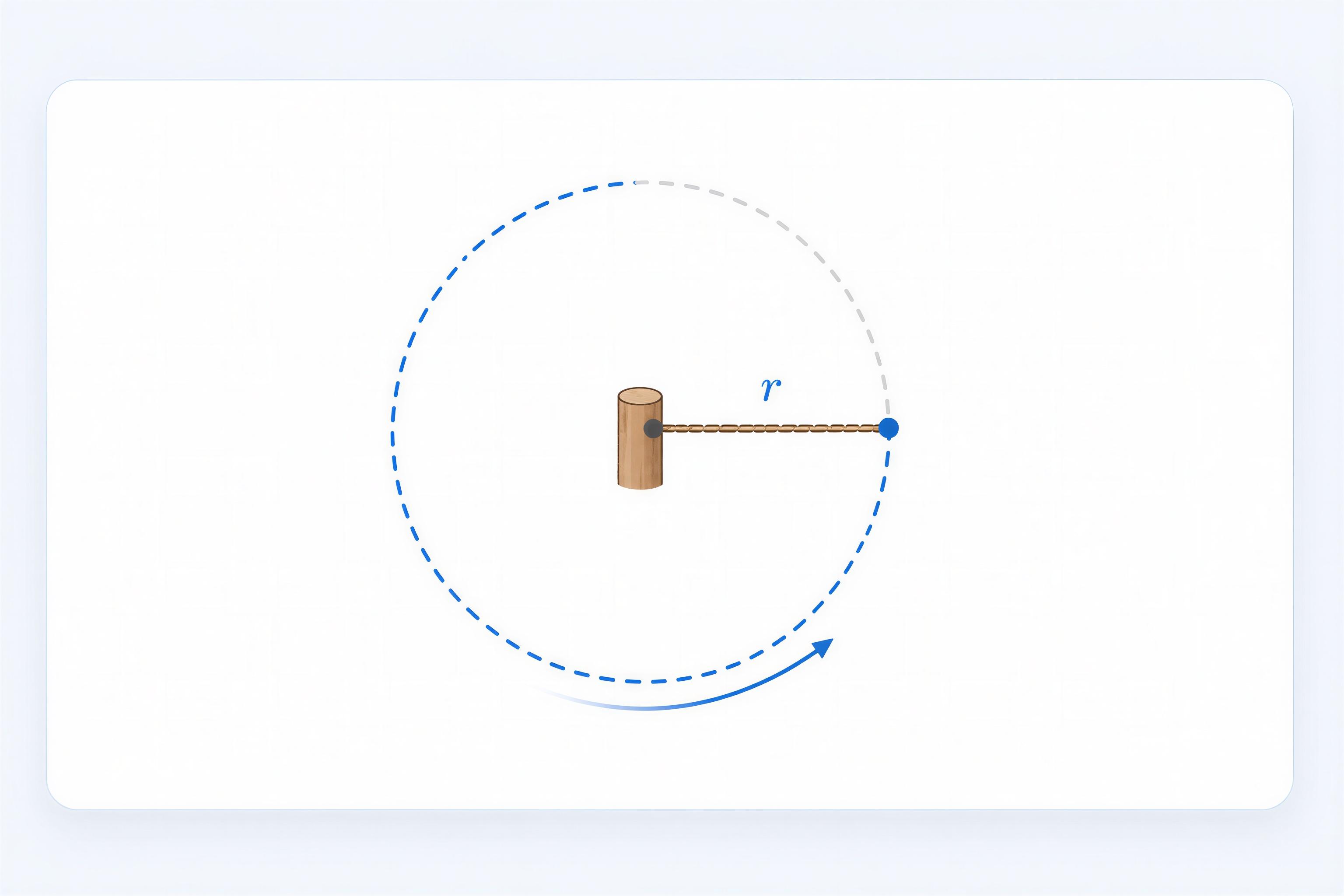
The equation of a circle
On a graph, we can place the centre at the origin . If the rope length is , then every point on the circle is exactly units from the origin.
Now take one point on the circle and call it . Its horizontal distance from the origin is , its vertical distance is , and its direct distance from the origin is the radius .
Anatomy of the triangle
Those three distances form a right-angled triangle. If we remember the Pythagorean theorem, we have:
In our case, the horizontal distance is , the vertical distance is , and the hypotenuse is the radius . So we can rewrite the formula as:
This is not a random formula. It allows us to describe every point on the edge of the circle using Pythagoras' theorem.
Two parts of the equation
Distance being tested
This calculates the squared distance of the point from the origin.
Required radius
This says the squared distance must match a circle with radius units.
So means every allowed point is exactly units from the centre.
Think of the equation like a security check for the circle. Give it a coordinate , and it squares the two values, adds them together, then checks whether the total matches .
Look at this circle equation:
The right side is , so and .
So the radius is . for a point to be on the edge of the circle it must be exactly 5 units from the center.
Testing a point
We can now test whether points belong on the circle. We do this by comparing the squared distance of the point to the squared radius.
(3,4)
means on the circle.
(2,4)
means inside the circle.
(6,4)
means outside the circle.
That gives us a simple rule.
Inside, on, or outside the circle
- If , the point is on the circle.
- If , the point is inside the circle.
- If , the point is outside the circle.
Inside vs outside the circle
Blue: inside the circle.
Green: on the circle.
Red: outside the circle.
Explore the point testInteractive
Point test
Drag the green point or choose one of the examples.
means on the circle.
From this, it should be clear that points with a distance larger than the radius lie outside the circle. Points with a distance less than the radius lie within the circle, and points with a distance equal to the radius lie on the circle.
A common trap is to forget that the number on the right is the squared radius.
The radius is not . The equation says , so .
Circle equation cheat sheet
Centre
The circle is centred at .
Radius
The right-hand side is , so take the square root to find .
Meaning
tests the squared distance of a point from the origin.
Point test
Equal means on the circle. Smaller means inside. Larger means outside.